
THIS WEEK IN CLINICAL AI
THE PULSE
From Discovery to Dependability

The Brief: AI is already helping clinicians solve difficult diagnostic problems, but as its role expands into higher-stakes areas of care, experts are increasingly focused on making these systems more transparent, specialized, and accountable.
AI in Context
Researchers at Boston Children's Hospital used a general-purpose AI model to help identify 18 rare disease diagnoses that had remained unresolved despite years of clinical review.
The findings suggest AI can act as a powerful assistant for complex medical investigations, helping clinicians uncover patterns that might otherwise be missed.
Experts in medication safety argue that future clinical AI should combine clinician-developed knowledge, audit trails, and clear safeguards so recommendations can be traced, validated, and trusted in high-risk situations.
Why It’s Relevant: For healthcare leaders and clinicians, the next phase of AI adoption may be less about finding the smartest model and more about choosing systems that can explain their reasoning, operate within clinical safeguards, and support expert decision-making when the stakes are highest.
READ THE FULL ARTICLES HERE
PSYCHOLOGY & BEHAVIORAL HEALTH
Patients are bringing AI to therapy: Highlights from the 2026 Chatbots and Mental Health Survey
(APA, 2026)
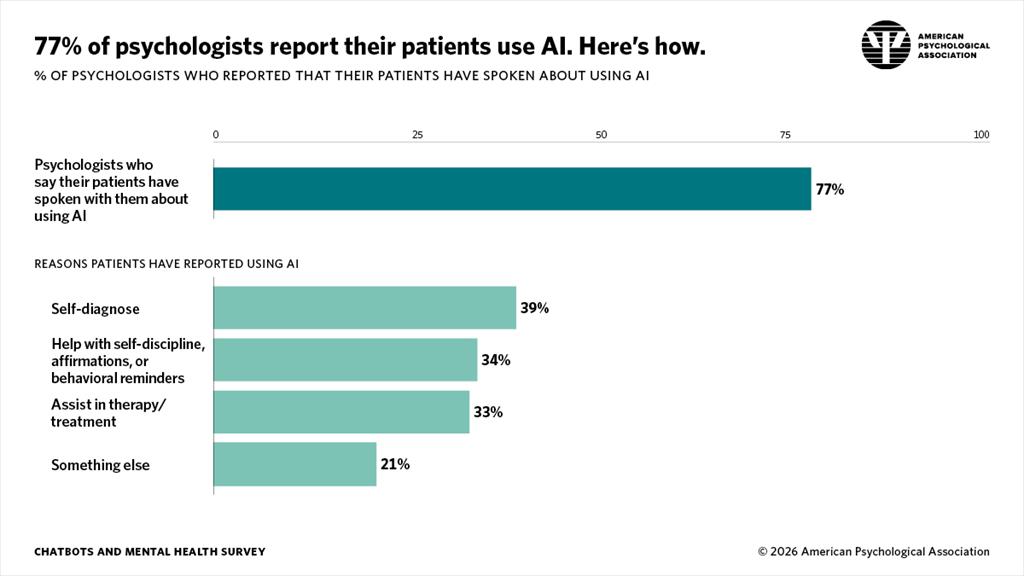
Image Source: APA
The Brief: AI is increasingly showing up in the therapy room, with patients using chatbots for everything from self-diagnosis and treatment support to companionship and emotional validation.
AI in Context
77% of psychologists reported discussing patient chatbot use, and 35% said patients viewed AI as an additional mental health professional.
The most common uses included self-diagnosis (39%), therapy support (33%), and behavioral reminders or affirmations (34%).
Patients are also using chatbots for friendship and relationships, though psychologists reported both perceived support and concerns about unhealthy interactions.
Why It’s Relevant: Clinicians may need to routinely ask about AI use during assessment and treatment planning, as these tools are increasingly influencing how patients understand and manage their mental health.
For better or worse, young people are turning to AI chatbots for emotional support
(CNN, 2026)

The Brief: A growing number of adolescents and young adults are using AI chatbots for emotional support, often without the knowledge of parents or clinicians.
AI in Context
19% of surveyed youth ages 12 to 21 reported using AI chatbots for emotional support, representing an estimated 8 million young people nationwide.
More than 40% of users engaged with chatbots at least monthly, and 91% said the advice felt somewhat or very helpful.
Nearly two-thirds of users did not tell anyone they were relying on chatbots for emotional support.
Why It’s Relevant: Mental health professionals may need to understand how AI is shaping coping strategies and emotional decision-making, particularly among younger clients who may be using these tools privately.
MEDICINE & CLINICAL INNOVATION
AI Legislative Update: June 12, 2026
(Transparency Coalition, 2026)

The Brief: Rhode Island lawmakers are advancing several AI-related bills that would require transparency, consent, clinician oversight, and safety safeguards when AI is used in mental health care.
AI in Context
S 2197 / H 7349: Would require written disclosure and patient consent whenever AI is used in therapy, while making clear that licensed clinicians must remain responsible for treatment decisions and care plans.
H 8242: Would limit the delivery of therapy and psychotherapy to licensed or certified professionals, allowing AI only as a supplemental or administrative tool under clinician supervision.
S 2195: Would require chatbot providers to implement safeguards for suicide and self-harm concerns, including protocols to identify risk and direct users to crisis support services.
Why It’s Relevant: If you're evaluating AI tools for clinical practice, these bills highlight three areas worth addressing now: documenting patient consent, clearly defining where AI supports rather than replaces clinical judgment, and ensuring vendors have robust crisis-response and safety protocols in place.
'World-first' vaccine designed by AI tested on humans: Will it live up to the hype?
(Medical News Today, 2026)

The Brief: Scientists have completed the first human trial of a vaccine designed with AI, using the technology to identify shared coronavirus features that could provide broader protection across the sarbecovirus family, including SARS and COVID-19.
AI in Context
AI analyzed multiple coronaviruses to create a "super antigen" that targets shared viral features, with the goal of providing protection against future mutations and related viruses before they emerge.
The vaccine is delivered without a needle, using a jet injector system that administers the vaccine through the skin.
After producing a modest immune response in an initial 39-person trial, researchers expanded testing to 200 participants and are applying the same AI-driven design approach to potential influenza and Ebola vaccines.
Why It’s Relevant: This work highlights how AI may accelerate early-stage biomedical discovery by helping researchers design broader and potentially more resilient vaccine candidates.
WAYDE AI INSIGHT
Healthcare AI is moving from possibility to practice. This month, AI helped identify rare disease diagnoses that had eluded clinicians for years and contributed to the development of a new vaccine candidate designed to protect against future coronavirus threats. At the same time, patients, especially younger ones, are increasingly turning to AI for emotional support and mental health guidance, often outside traditional care settings. These developments highlight both the promise and the challenge of this moment. AI is already proving it can be useful, but usefulness is not the same as dependability. As AI becomes more integrated into healthcare, leaders are increasingly focused on the safeguards, oversight, and validation needed to ensure AI recommendations can be understood, traced, and trusted in clinical settings.
If you are exploring how AI could fit into your practice or organization, we invite you to schedule a complimentary 30-minute strategy call to discuss opportunities, challenges, and practical next steps.
WANT MORE?
Ready to grow your AI literacy? Click on one of the materials below to start exploring.

AI in Healthcare: A Practical Starting Guide for Leaders and Clinicians

What is AI and Why It Matters

Teaching Students to Think With AI, Not Around It with Dr. David Williamson Shaffer
Upcoming Talk: July 13th, 2026

Helping healthcare professionals adopt AI ethically and responsibly.
Produced by Wayde AI with AI assistance.